- Products
- Service&Support
- Solution
- About Us
- News
- Contact Us
Views: 13028 Author: Site Editor Publish Time: 2015-08-25 Origin: Site


A strain gauge is a device used to measure strain on an object. Invented by Edward E. Simmons and Arthur C. Ruge in 1938, the most common type of strain gauge consists of an insulating flexible backing which supports a metallic foil pattern. The gauge is attached to the object by a suitable adhesive, such as cyanoacrylate. As the object is deformed, the foil is deformed, causing its electrical resistance to change. This resistance change, usually measured using a Wheatstone bridge, is related to the strain by the quantity known as the gauge factor.
A strain gauge takes advantage of the physical property of electrical conductance and its dependence on the conductor's geometry. When an electrical conductor is stretched within the limits of its elasticity such that it does not break or permanently deform, it will become narrower and longer, changes that increase its electrical resistance end-to-end. Conversely, when a conductor is compressed such that it does not buckle, it will broaden and shorten, changes that decrease its electrical resistance end-to-end. From the measured electrical resistance of the strain gauge, the amount of induced stress may be inferred.
A typical strain gauge arranges a long, thin conductive strip in a zig-zag pattern of parallel lines. This does not increase the sensitivity, since the percentage change in resistance for a given strain for the entire zig-zag is the same as for any single trace. However, a single linear trace would have to be extremely thin and hence liable to overheating (which would both change its resistance and cause it to expand), or would have to be operated at a much lower voltage, making it harder to measure resistance changes accurately.


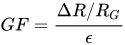
The gauge factor {\displaystyle GF}
{\displaystyle GF={\frac {\Delta R/R_{G}}{\epsilon }}}
where
{\displaystyle \Delta R}
{\displaystyle R_{G}}
{\displaystyle \epsilon }
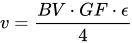
For common metallic foil gauges, the gauge factor is usually a little over 2. For a single active gauge and three dummy resistors of the same resistance about the active gauge in a Wheatstone bridge configuration, the output {\displaystyle v}
{\displaystyle v={\frac {BV\cdot GF\cdot \epsilon }{4}}}
where
{\displaystyle BV}
Foil gauges typically have active areas of about 2–10 mm2 in size. With careful installation, the correct gauge, and the correct adhesive, strains up to at least 10% can be measured.